
2026 Stablecoin Payment Volume and Market Scale
The stablecoin market has transitioned from a speculative asset class to a foundational settlement rail. By mid-2026, adjusted transaction volumes reached record levels, with June alone reporting $1.79 trillion in processed value [src-serp-7]. This scale reflects a structural shift in cross-border B2B payments, where stablecoins are increasingly displacing traditional correspondent banking for high-value, time-sensitive settlements.
The growth trajectory is driven by regulatory clarity and institutional adoption. Cross-border B2B stablecoin payments are projected to reach $5 trillion by 2035, up from approximately $13.4 billion in 2026 [src-serp-3]. This exponential growth underscores the efficiency gains of using stablecoins for immediate settlement, reducing the friction and latency associated with legacy credit card networks.
To visualize the stability and volume trends of the leading settlement asset, the following chart tracks USDT/USD performance. This data highlights the resilience of stablecoin markets even as transaction volumes surge.
Regulatory clarity and the Genius Act
The passage of the Genius Act in July 2025 marked a structural shift in the U.S. payments landscape, providing the first comprehensive federal framework for payment stablecoins. Prior to this legislation, merchants and consumers faced significant legal ambiguity regarding the compliance of digital asset settlements. The Act resolved this by defining the operational requirements for stablecoin issuers, effectively legitimizing QR code-based settlements as a compliant alternative to traditional credit card networks.
This regulatory clarity has directly reduced legal risk for businesses adopting stablecoin payments. By establishing clear reserve requirements and consumer protection standards, the Genius Act allows merchants to process transactions with the same confidence they apply to fiat settlements. The Federal Reserve’s recent analysis underscores that this framework supports the integration of stablecoins into the broader financial system, particularly for cross-border payments where speed and lower costs are critical [1].
Industry adoption has accelerated in response to this clarity. The payment infrastructure community, including NACHA, has integrated stablecoin processing into major industry events like Smarter Faster Payments 2026, signaling that stablecoins are no longer experimental but a core component of the modern payments stack [2]. This institutional acceptance is driving the rapid replacement of credit cards in sectors where instant settlement and lower fees are prioritized.
QR Codes and Instant Settlement Mechanics
The transition from credit card processing to stablecoin settlements is defined by the removal of intermediary clearinghouses. Traditional card networks rely on a multi-party authorization and clearing cycle that typically requires two business days (T+2) to finalize. This delay creates working capital friction for merchants and exposes issuers to chargeback risk during the pending period. In contrast, QR-based stablecoin payments utilize blockchain ledgers to record transactions in real time. Once a merchant scans a consumer’s QR code, the transfer is broadcast to the network, providing immediate finality without the need for batch processing.
This structural shift fundamentally alters fee structures. Credit card interchange fees, which often range from 1.5% to 3.5% depending on the card network and merchant category, are replaced by minimal on-chain gas fees or fixed platform rates that frequently fall below 1%. The efficiency gain is not merely cosmetic; it represents a compression of the payment rails themselves. By bypassing the Visa or Mastercard authorization networks, merchants retain higher margins on low-value transactions that are otherwise economically unviable due to fixed processing costs.
The mechanics of this speed rely on the deterministic nature of blockchain consensus. While traditional systems require reconciliation between acquiring banks, issuing banks, and card networks, stablecoin settlements occur directly between the payer and payers’ digital wallets. This direct settlement model eliminates the reconciliation lag inherent in legacy banking infrastructure. As demonstrated by the rapid adoption of QR standards in emerging markets, the technical advantage of instant liquidity is becoming the primary driver for enterprise integration.
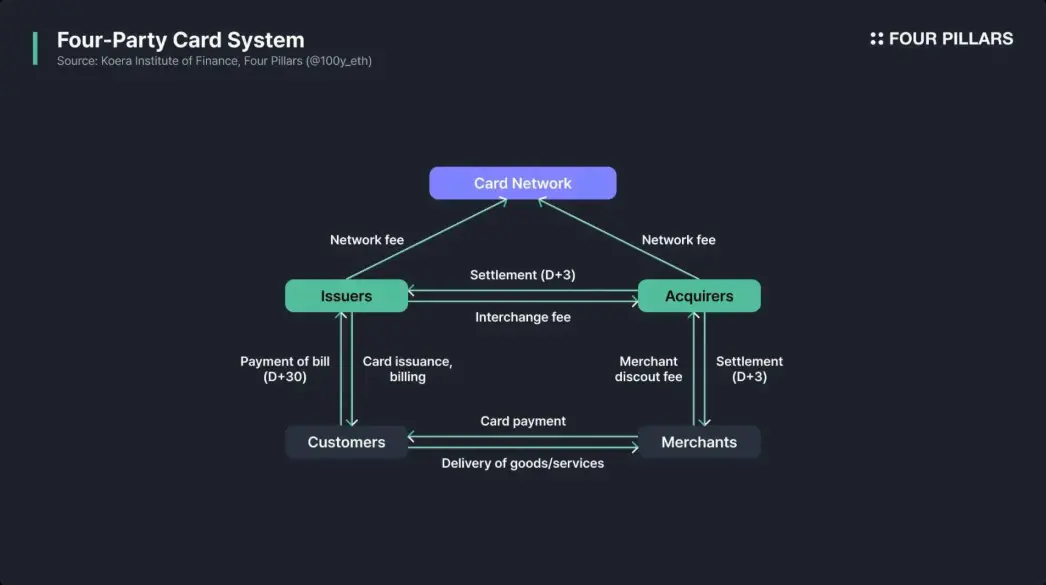
The contrast between these two systems is best understood through a direct comparison of their operational metrics.
| Metric | Credit Card Network | Stablecoin QR Payment |
|---|---|---|
| Settlement Time | T+2 Days | Instant (Seconds) |
| Typical Fees | 1.5% – 3.5% | < 1% |
| Reconciliation | Multi-party batch | Direct on-chain |
| Chargeback Risk | High | Minimal |
While the technical superiority of instant settlement is clear, the transition requires rigorous compliance frameworks. The speed of stablecoin transactions does not exempt merchants from Anti-Money Laundering (AML) obligations. Instead, it shifts the burden of verification to the digital wallet layer, where identity verification (KYC) is often integrated into the user experience. This integration ensures that the speed of the payment rail does not compromise the regulatory integrity of the financial system.
Blockchain rails and network concentration
The infrastructure carrying stablecoin payments has shifted significantly. In 2026, the dominance of Ethereum L1 has waned as transaction costs and latency issues pushed high-volume use cases toward alternative networks. According to the Boston Consulting Group, TRON has emerged as the dominant rail for stablecoin payments, handling a substantial share of real-world transaction volume due to its low fees and high throughput [[src-serp-1]].
This concentration is not merely a technical preference but a structural response to the economics of cross-border commerce. While Ethereum remains critical for institutional settlement and smart contract complexity, it is less efficient for the high-frequency, low-value transfers that characterize QR code-based retail payments. The network effects of TRON’s existing user base create a barrier to entry for newer chains attempting to capture this specific segment.
The implications for payment processors are clear. Integrating with the dominant rails reduces friction for merchants and consumers alike. However, this reliance on a few concentrated networks introduces systemic risk. As cross-border B2B payments are projected to grow, the stability and regulatory compliance of these specific blockchains will become a primary focus for financial regulators.
Adoption risks and digital wallet security
The transition from traditional credit card rails to instant stablecoin settlements introduces a distinct set of operational risks. While the Federal Reserve notes that the 2025 Genius Act provides a foundational regulatory framework for payment stablecoins, compliance alone does not guarantee transactional security. The structural shift places the burden of custody and key management directly on the merchant, creating a steep learning curve for businesses accustomed to the chargeback protections and fraud liability shifts inherent in Visa or Mastercard networks.
Digital wallet security is the primary barrier to mass merchant adoption. Unlike centralized payment processors that absorb risk, stablecoin transactions are irreversible. A single error in wallet configuration or a compromise in private key management can result in permanent loss of funds. For high-volume merchants, this necessitates a move toward non-custodial solutions with multi-signature (multi-sig) requirements. These protocols require multiple authorized parties to approve transactions, significantly reducing the risk of internal fraud or single-point-of-failure breaches.
Beyond technical security, the regulatory landscape remains in flux. While projections suggest stablecoins could represent 3% of all US dollar payments by 2026, the operational infrastructure for monitoring and reporting these transactions is still maturing. Merchants must integrate robust compliance tools to track on-chain activity and ensure adherence to anti-money laundering (AML) standards. The cost of building this internal compliance layer currently outweighs the transaction fee savings for many small-to-mid-sized businesses, slowing broader adoption despite the technological advantages.
No comments yet. Be the first to share your thoughts!