
The 2026 Regulatory Shift for Stablecoins
The legal landscape for digital payments changed fundamentally in July 2025 with the passage of the Genius Act. This legislation established the first comprehensive federal framework for stablecoin issuance in the United States. By defining clear rules for reserves and issuer liability, the law moved stablecoins from a speculative gray area into a regulated payment rail.
The market reacted immediately. According to the International Monetary Fund, U.S. legislation supporting stablecoin payments reduced the market value of listed incumbent payment firms by 18%, or approximately $300 billion. This shift signals a structural change in how payment value is captured, moving influence from traditional processors toward regulated digital issuers.
Data confirms that the regulatory clarity accelerated adoption. Adjusted transaction volume, which had been rising steadily, saw significant acceleration after the Act passed. By Q1 2026, adjusted volume reached roughly $4.5 trillion. The Genius Act did not create this demand but provided the legal certainty required for mainstream institutional participation.
This transition from speculation to utility establishes stablecoins as a legitimate component of the financial infrastructure. For legal and financial stakeholders, the focus is no longer on whether stablecoins will be used, but on how existing systems must adapt to this new, regulated reality.
Market growth and transaction volumes
Stablecoin payments have transitioned from experimental use cases to a significant component of global digital commerce. By 2025, transaction volumes reached approximately $390 billion, representing more than a doubling of activity from the prior year. This growth trajectory accelerates further in 2026, where adjusted payment volumes are estimated to reach roughly $4.5 trillion in the first quarter alone. The market capitalization across all chains also reflects this expansion, stabilizing near $316 billion as of early 2026.
The scale of adoption is particularly evident in the United States, where regulatory clarity has begun to structure the market. Industry projections indicate that stablecoins will represent 3% of all US dollar payments in 2026, with expectations of rising to 10% by 2031. This shift is not merely speculative; it is anchored in the implementation of the GENIUS Act, which established the first federal guidelines for stablecoin issuance.
To contextualize this liquidity, consider the depth of the underlying assets. The following chart illustrates the market dynamics and trading volume trends for major stablecoin assets, reflecting the infrastructure scale that supports these transaction volumes.
QR codes bridge crypto and physical retail
The friction of digital asset adoption often lies in the disconnect between on-chain settlement and physical commerce. QR code payments solve this by allowing offline merchants to accept stablecoins instantly without requiring complex wallet setups or deep technical knowledge from either party. This mechanism transforms the smartphone camera into a point-of-sale terminal, effectively bridging the gap between traditional retail infrastructure and decentralized finance.
When a customer scans a merchant’s QR code, the transaction initiates a direct transfer of tokens—typically USDC—on a high-throughput network like Solana, Ethereum, or Polygon. The merchant does not need to manage private keys or navigate decentralized exchanges. Instead, the payment gateway handles the blockchain interaction in the background, confirming the transaction within seconds. This process mirrors the familiarity of scanning a credit card reader, but settles on the blockchain rather than through a legacy banking clearinghouse.
The user experience is designed to be invisible to the uninitiated. For the consumer, the action is identical to using a mobile banking app to send money: they scan a code, confirm the amount, and sign the transaction with their device’s biometric authentication. For the merchant, the benefit is immediate access to funds without the multi-day settlement delays and high interchange fees associated with traditional card networks. This efficiency is a primary driver for adoption, as users cite lower fees (30%) and global access (27%) as key motivators for choosing stablecoin payments over conventional methods.
Major payment processors are already integrating this infrastructure. Stripe, for instance, accepts stablecoin payments from customers in over 70 countries, settling them to merchants in stablecoins like USDC. This integration allows retailers to accept crypto payments while maintaining the stability of fiat-pegged assets, reducing exposure to cryptocurrency volatility. The result is a payment rail that offers the speed of digital assets with the predictability of traditional currency, making it viable for everything from small coffee shops to large-scale e-commerce operations.
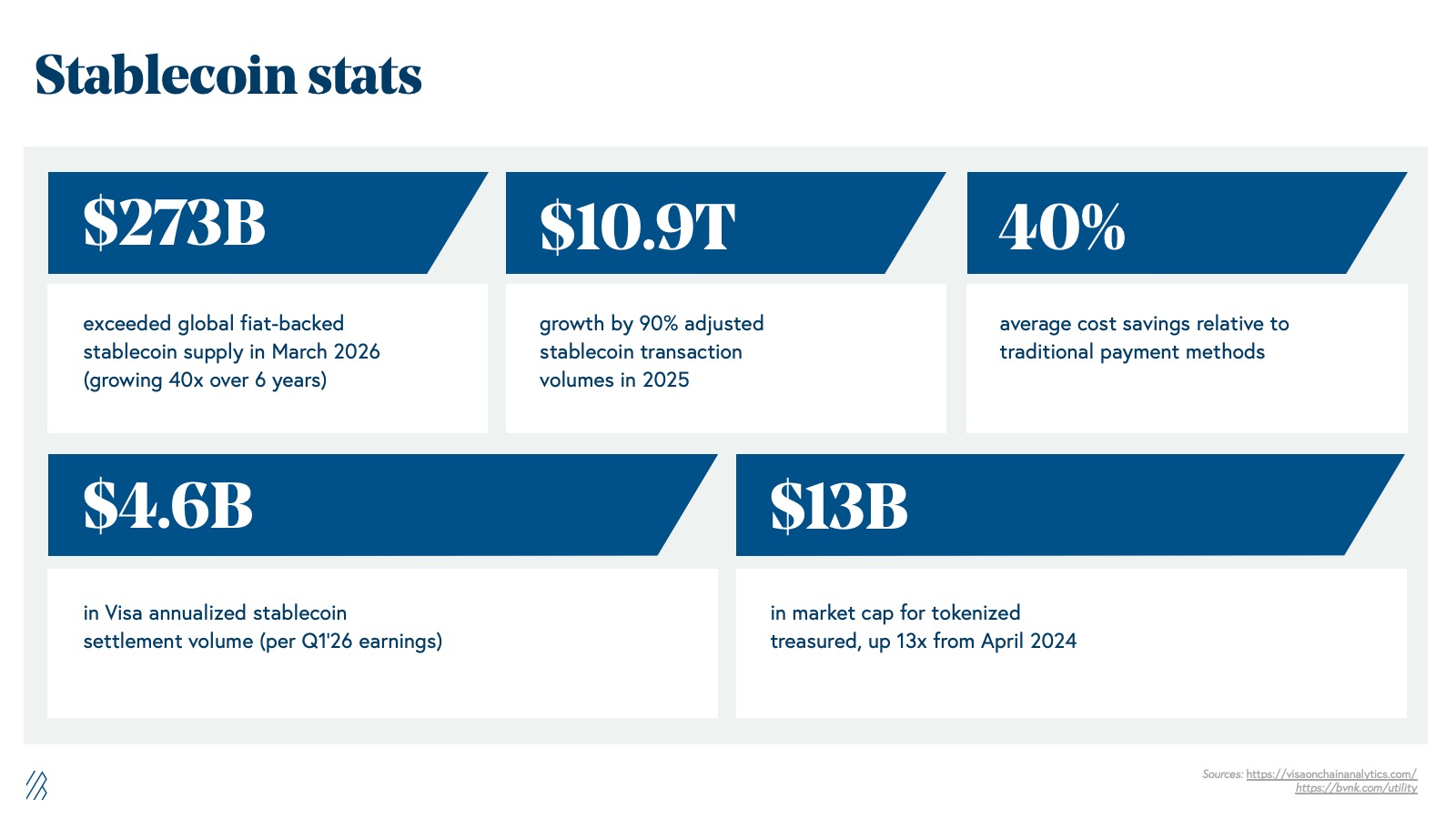
The regulatory landscape is beginning to catch up with this technological shift. In the United States, the GENIUS Act established the first federal framework for stablecoin issuance, providing the legal clarity needed for widespread retail adoption. This legislative support, combined with the technical simplicity of QR-based payments, is accelerating the transition of stablecoins from a niche DeFi primitive to a mainstream global financial infrastructure. As volume grows—reaching roughly $4.5 trillion in Q1 2026—the QR code has emerged as the critical interface for bringing these digital dollars into the physical economy.
Major processors enter the stablecoin space
The integration of stablecoin payments by major payment processors marks a shift from experimental adoption to institutional infrastructure. Stripe, a dominant player in global payment processing, now accepts stablecoin payments from customers in over 70 countries. This integration allows merchants to receive payments in cryptocurrencies like USDC on networks such as Solana, Ethereum, or Polygon, with automatic settlement to their existing bank accounts.
This development provides a critical bridge for traditional merchants. By handling the volatility and compliance layers internally, processors like Stripe allow businesses to accept crypto without maintaining direct custody of digital assets. The GENIUS Act's establishment of a federal framework for stablecoin issuance has further accelerated this trend, with adjusted transaction volumes reaching roughly $4.5 trillion in Q1 2026.
The efficiency gains are measurable when comparing traditional fiat rails to stablecoin settlement. While cross-border fiat transfers often take days and incur high intermediary fees, stablecoin transactions settle in seconds with significantly lower costs. This comparison highlights the operational advantage for merchants processing international or high-volume transactions.
| Feature | Traditional Fiat | Stablecoin (USDC) |
|---|---|---|
| Settlement Time | 1-3 business days | Seconds |
| Cross-Border Cost | 3-5% + fixed fees | <0.1% network fee |
| Merchant Integration | Standard API | Existing gateway API |
| Volatility Risk | None (Fiat) | Settled instantly to bank |
This infrastructure allows retailers to leverage the speed of blockchain technology while maintaining the regulatory compliance and financial stability expected by traditional banking partners. The move by Stripe and similar entities validates stablecoins as a viable settlement layer for retail commerce.
Cross-border payments and lower fees
The economic case for stablecoins in global commerce rests on two measurable advantages: instant settlement and reduced transaction costs. Traditional wire transfers, particularly for cross-border transactions, involve multiple intermediary banks, correspondent banking fees, and settlement delays that can span several business days. Stablecoins bypass this fragmented infrastructure by settling on-chain, often within minutes, regardless of geographic boundaries.
Data from BVNK indicates that lower fees are a primary driver for current stablecoin adoption, cited by 30% of users as a key utility. This cost reduction is particularly significant for small-value transactions where traditional banking fees often exceed the transaction amount itself. By eliminating or reducing the need for correspondent accounts in multiple jurisdictions, businesses can retain more capital and improve cash flow visibility.
The shift is reflected in broader market data. Following the passage of the GENIUS Act in the U.S., which established the first federal framework for stablecoin issuance, adjusted transaction volumes accelerated. Q1 2026 saw volumes reach approximately $4.5 trillion, signaling a structural shift rather than temporary speculation. This growth underscores the utility of stablecoins as a settlement layer for global trade, offering a more efficient alternative to legacy systems for both B2B and retail cross-border payments.
Common questions about stablecoin checkout
Stablecoin adoption is shifting from speculative trading to utility-driven payments, particularly in cross-border settlements and retail QR checkouts. The following analysis addresses frequent questions regarding growth metrics and regulatory compliance based on official filings and market data.
No comments yet. Be the first to share your thoughts!